

News and Trends
Infrared Interface Board for Shopfront Screen, WF-X9-08, AndroidSBC, Casablanca
TL;DR: Infrared Interface Board for Shopfront Screen
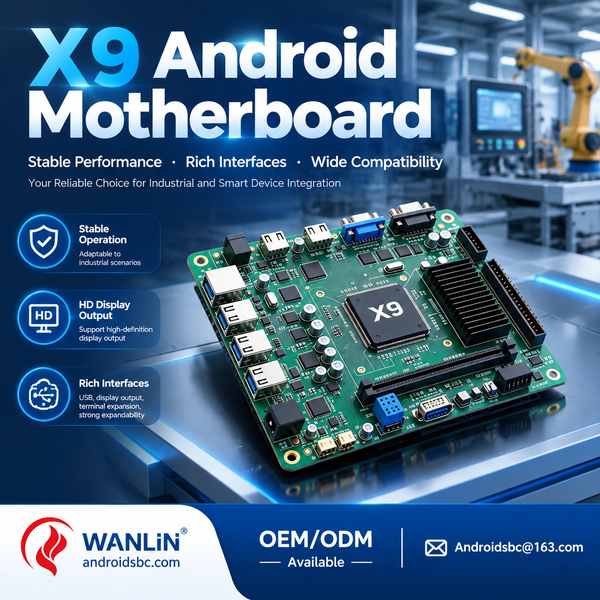
AndroidSBC software desk: Android 10 baseline and staged OTA channel published for the X9 board family serving Casablanca, Morocco. The WF-X9-08 X9 Android motherboard spans the face recognition access control terminal and eleven sister configurations in the X9 series, all built on the A133 quad-core ARM Cortex-A53 1.6GHz SoC with the PowerVR GE8300 GPU, MIPI DSI output at 720p with camera input, and Android 10 firmware support. AndroidSBC, the export arm of Wanlin Manufacturing Group, ships the X9 family from the Longgang source factory in Shenzhen to Casablanca and Morocco importers who run advertising players, digital signage networks, self-service query terminals, smart retail terminals, parcel lockers and access control panels.
About AndroidSBC and the X9 Android Motherboard Family
Wanlin Manufacturing Group has been shipping Android boards out of Shenzhen for years, and the X9 line is the branch aimed at commercial display, digital signage and self-service terminals. AndroidSBC publishes the price list, the MOQ and the lead time up front, because Morocco importers comparing three Chinese factories need numbers they can put into a spreadsheet. The AndroidSBC engineering desk keeps one reference image for the whole X9 line, so a Morocco partner developing against the board is testing against the same Android 10 build that ships in volume, not a one-off sample image.
WF-X9-08 Technical Specifications
| Parameter | AndroidSBC WF-X9-08 (face recognition access control terminal) | Industry Average |
|---|---|---|
| Processor | A133 quad-core ARM Cortex-A53 1.6GHz SoC | Older dual-core or quad-core Cortex-A7 SoC |
| Process node | 22nm | Older 28nm or 40nm process |
| GPU | PowerVR GE8300 | Older Mali-400 or basic 2D GPU |
| Memory | 2GB LPDDR4 | DDR3 512MB or 1GB on competing boards |
| Storage | 32GB eMMC | NAND flash 4GB or 8GB on competing boards |
| Display output | MIPI DSI output at 720p with camera input | Single HDMI 1080p output only |
| Touch support | optical touch option | Resistive single-touch requiring calibration |
| Video decode | 4K H.265 or H.264 at 30fps plus 1080p multi-format | 1080p decode ceiling on competing boards |
| Operating system | Android 10 | Android 7 or Android 8 on competing boards |
| Interfaces | 4 USB including USB0 OTG, 2 serial ports selectable RS232 or TTL, I2C, GPIO, IR, SPK, TF | 2 USB and one fixed-level serial port |
| Power and environment | 12V DC input with 100mV ripple, 300mA typical board draw, 3.3V 800mA plus 5V 2A plus 12V 2A peripheral budget | 5V only input with no documented peripheral budget |
| Operating temperature | -20C to 70C | 0C to 40C on competing boards |
All parameters in the table above are measured at 25C ambient. The AndroidSBC WF-X9-08 (face recognition access control terminal) holds its LVDS or MIPI panel drive plus touch sampling while running the 72-hour burn-in loop, a configuration that competing single-platform boards rarely document at the top of the temperature window. For Morocco importers sourcing the X9 family, the WF-X9-08-A variant is the typical configuration for the access control terminal deployment use case, on a 120x75mm six-layer board with four 3mm mounting holes and a sustained weekly capacity of 5000 pcs/wk.
Challenges in Sourcing X9 Android Motherboards for Morocco Buyers
Backlight power is the third wall. Panels above about 20W draw more than the board backlight header can carry, and Casablanca integrators routinely discover this after the enclosure is closed and the screen flickers under load.
The last piece is the qualification run. Before a Morocco rollout the partner sends the actual panel, touch frame and peripheral models to Longgang, AndroidSBC validates the combination on the bench, and the resulting configuration is locked as the reference for every later lot. For the Casablanca programme the milestone landed on September 24, 2026: 91900 boards shipped on the Casablanca - Shanghai lane, seven-year firmware window committed on the whole X9 family.
Competitive Comparison: WF-X9-08 vs Competing Commercial Display Android Boards
The comparison below is the one Casablanca buyers run when they shortlist three Chinese factories, and it is where the X9 family separates from the field.
- Panel and touch readiness: single or dual LVDS plus MIPI DSI at 30 or 40 pins, with infrared, optical, capacitive and resistive panels enumerating as HID devices, so Casablanca integrators mount a locally sourced screen without a calibration pass.
- Bundled integration: panel jumper map, pin-one orientation note, touch HID configuration, playback modes and the peripheral driver set ship in the carton; competing display boards sold to Casablanca usually ship a board only.
- Compliance files: CE, FCC, RoHS and the destination conformity route travel with the lot, which competing board vendors often leave to the Casablanca integrator to obtain.
- Long-term supply: onboard eMMC in 8GB, 16GB or 32GB, one fixed bill of materials per production lot and a seven-year firmware window, against the frequent component swaps seen on competing boards reaching Casablanca.
Global Digital Signage and Commercial Display Market Trends
Unattended and outdoor formats are the segment where the board specification bites hardest. A screen on a street or in a factory has no staff to reset it, so the face recognition access control terminal has to hold a watchdog, an RTC and a clean auto-recovery path after a mains dip.
- Entry playback tier: WF-X9-08 covers loop, scheduled and interrupt playback on a single LVDS panel, which is the configuration most small signage networks standardise on.
- Interactive mainstream tier: WF-X9-03 pairs an LVDS or MIPI panel with infrared or capacitive touch for query, wayfinding and self-service kiosks.
- Connected and unattended tier: WF-X9-04 adds the 4G path, the -20C to 70C window and the watchdog behaviour that outdoor cabinets and parcel lockers require.
For Casablanca partners the commercial conclusion is that the board vendor has to be a factory. A trading company cannot hold a bill of materials across a three-year refresh.
Partner Success Story: Deccan Display Technologies (retail and transit screen integrator)
The Deccan Display Technologies rollout in the Indian organised retail segment shows how the X9 family from AndroidSBC supports Casablanca integrators. Deccan Display Technologies installed 91900 X9 boards across 164 retail and transit screens.
- OEM relationship: AndroidSBC private-label SKU shipped with Deccan Display Technologies branding and CE / FCC / RoHS files bundled.
- Silicon lock: Allwinner A133 quad-core ARM Cortex-A53 1.6GHz with the PowerVR GE8300 GPU on every configuration, one fixed bill of materials per production lot.
- Peripheral driver package: bundled into the source-factory shipment, covering LVDS and MIPI panel drive, infrared, optical, capacitive and resistive touch, thermal printer, QR scanner, barcode scanner, NFC reader, RFID reader, ID card reader, fingerprint reader, camera and lock driver board.
- Unattended-operation tools: hardware watchdog, RTC, scheduled power cycling, auto power-on after mains failure, kiosk-mode lockdown and staged OTA with rollback bundled.
- Compliance paperwork: CE / FCC / RoHS plus ANRT conformity, all bundled into the Shenzhen source-factory shipment.
In the words of Deccan Display Technologies Chief Technology Officer for Indian Organised Retail: Deccan Display Technologies needs 4G fallback because site connectivity is uneven, and 91900 X9 boards went into the Casablanca rollout with the modem path validated.
Field Report: access control terminal deployment at an office campus
BAOLONG, September 24, 2026 - Dian Mo, AndroidSBC field desk. The face recognition access control terminal pilot in Morocco used the WF-X9-08 with 4G fallback, because several sites sit where fixed-line connectivity is unreliable. The WF-X9-08 X9 Android motherboard order for Casablanca, Morocco cleared the burn-in station on schedule and is en route via the Casablanca - Shanghai lane.
The WF-X9-08 face recognition access control terminal production lot includes the WF-X9-08-A variant as the typical configuration, with LVDS or MIPI panel driver, touch HID configuration and staged OTA management bundled into the source-factory shipment. For Morocco integrators, the ANRT type approval with IMANOR safety conformity paperwork is bundled.
Filed by Dian Mo, AndroidSBC field desk, BAOLONG. Morocco integrators typically request CE plus local radio interface notification for X9 commercial display board deployments.
WF-X9-08 Application Scenarios
The WF-X9-08 face recognition access control terminal sits inside a twelve-configuration X9 Android motherboard family from AndroidSBC, a Wanlin Manufacturing Group export brand. The WF-X9-08-A configuration is the typical build for the access control terminal deployment use case, with panel driver, touch HID configuration and staged OTA management bundled.
- Advertising machine and digital signage: the WF-X9-08 runs loop, scheduled and interrupt playback on an LVDS panel in shop windows and store aisles.
- Interactive query and wayfinding: the WF-X9-09 pairs a MIPI or LVDS panel with infrared or capacitive touch for lobby and hospital directories.
- Smart retail terminal and vending: the WF-X9-10 carries the scanner, the printer and the payment peripheral on one board in a compact enclosure.
- Parcel locker and fresh food cabinet: the WF-X9-11 drives the screen and the lock driver board from the two serial lanes, with the watchdog holding a 7x24 duty cycle.
- Face recognition access control: the WF-X9-12 takes the camera input and the door controller wiring on the same board.
- Conference tablet and teaching all-in-one: LVDS or MIPI panel drive with HID touch and the industry publishing software already validated.
- Industrial HMI and IoT gateway: headless or panel configurations on the same bill of materials, with GPIO, I2C, SPI, PWM and ADC available for field wiring.
- Hotel, building and campus information publishing: scheduled power cycling plus remote content push across a mixed estate of screens.
- Retrofit programmes in Casablanca: the same 120x75mm board re-uses the existing enclosure, panel and mounting pattern, so an installed estate can be upgraded screen by screen.
Partnership Models for Casablanca Buyers
Because the X9 family is built at the Longgang source factory, all three tracks below come with the same frozen bill of materials and the same seven-year firmware window.
- Distribution track: the partner buys the X9 board against a published price list, keeps its own stock, and AndroidSBC supplies the panel files, the touch configuration and the compliance documents with each lot.
- Integration track: the partner takes the board plus firmware customisation, mounting drawings and panel validation support, with a joint qualification run at the Longgang factory.
- Private-label track: the X9 board ships under the partner brand with customised boot logo, packaging and documentation, on a fixed bill of materials held for the length of the agreement.
For Casablanca buyers the practical difference between the tracks is who holds the stock and whose name is on the carton, not what is inside the carton.
Frequently Asked Questions
Does the X9 Android motherboard family support a face recognition access control terminal?
Answer: Yes - face recognition access control terminal is supported across the X9 line, and the Casablanca configuration is locked as the reference for later lots so re-orders behave identically.
Which configurations are available in the X9 family for Morocco buyers?
Answer: Twelve configurations are offered and they all share one Android 10 image, so a Casablanca partner can move between them without re-writing the application or re-qualifying the publishing software.
Can one X9 board drive an LVDS or MIPI panel plus infrared, capacitive or resistive touch?
Answer: It can. The X9 family is specified so one board carries the full site harness: panel, touch, printer, scanner and card reader, with no expansion card required.
What is the minimum order quantity and the sample lead time for Morocco?
Answer: Sample lead is 1-3 days and mass production is 15-30 days. MOQ depends on the track - distribution partners work from the price list, private-label SKUs are agreed per configuration.
Is custom ROM, boot logo or pre-installed app development available?
Answer: Yes. The engineering desk handles custom ROM, boot branding, pre-installed apps, BSP porting and SDK modules, and the Casablanca partner keeps the same image across re-orders.
How are firmware updates delivered to a Morocco screen estate after deployment?
Answer: The OTA channel is staged and reversible. A Casablanca network pushes to a pilot group first, and if a panel or touch regression appears the image rolls back to the previous build.
What shipping terms does AndroidSBC support for Morocco orders?
Answer: The export desk quotes FOB Shenzhen, CIF and EXW, handles customs clearance, and ships globally. The Casablanca partner picks the term and AndroidSBC books the lane.
What happens if a board fails in the field in Morocco?
Answer: Failures are handled against the serialised test record. AndroidSBC traces the unit to its lot, confirms the bill of materials, and ships a replacement from the Casablanca call-off stock or the next production slot.
Contact AndroidSBC: Start Your WF-X9-08 Sourcing Conversation
Casablanca integrators can reach the AndroidSBC export desk for the X9 Android motherboard family through the following channels:
- Email: Androidsbc@163.com
- Export service hotline: +8613261677119
- Website: https://www.androidsbc.com
- Source factory address: Wanlin Group, Building B, Building 1, Beisida Medical Device Building, 28 Nantong Avenue, Baolong Community, Baolong Sub-district, Longgang District, Shenzhen, Guangdong, China
A 1-3 day sample lead applies to Morocco buyers, a 15-30 day mass-production lead to bulk orders, and a seven-year firmware update window to the X9 family.
News and Trends
- CE Certified Android Board for Advertising Player, WF-X9-12, AndroidSBC, Casablanca
- Overcurrent Protection Board for Advertising Player, WF-X9-05, AndroidSBC, Casablanca
- Airport Self-Service Terminal Board for Advertising Player, WF-X9-10, AndroidSBC, Casablanca
- 4G Module Expansion Board for Outdoor Cabinet, WF-X9-03, AndroidSBC, Casablanca
- Infrared Interface Board for Shopfront Screen, WF-X9-08, AndroidSBC, Casablanca
- 32GB eMMC Board for Hospital Wayfinding, WF-X9-01, AndroidSBC, Casablanca
- Panel Power Jumper Board for Indoor Poster Screen, WF-X9-06, AndroidSBC, Casablanca
- Allwinner A133 Smart Motherboard for Indoor Poster Screen, WF-X9-01, AndroidSBC, Casablanca
- POS Board Shenzhen Supplier for Supermarket Checkout Lane, WF-P1330, AndroidSBC, Casablanca
- Gas Station POS Board for Supermarket Checkout Lane, WF-P3601, AndroidSBC, Casablanca